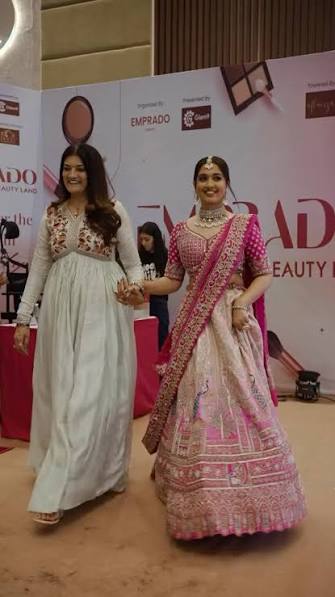
The hand in the cloth
A bridal lehenga is one of the last mass-visible objects in modern life that is still, substantially, made by hand. It is worth knowing whose hands.
Look closely at the garments in any Indian wedding photograph and the surface resolves into technique. What reads at a distance as generalised richness is in fact a small number of named crafts, each with its own geography, its own tools and its own workshop culture — and each recognisable once you know what you are looking at.
Four techniques, four cities
Zardozi is metal-thread embroidery worked with a hooked needle called an aari, on fabric held taut across a wooden frame. Historically it used gold and silver wire; today it more often uses metallic thread, sequins, dabka coils and beads. Its centres are Lucknow, Delhi, Bhopal and Hyderabad. It is what produces the dense, raised, faintly architectural surfaces on heavy bridalwear.
Gota patti is a Rajasthani technique in which narrow strips of metallic ribbon are folded and appliquéd into leaves, petals and geometric borders. It is lighter than zardozi and reflects differently — broad flashes rather than fine glitter — which is why it survives well in photographs taken under stage lighting.
Mukaish, also from Lucknow, involves twisting tiny points of metal wire through the fabric so that the surface carries a scatter of small, hard highlights. Worked densely enough it is called hazaar butti — a thousand dots. It is among the most endangered of these crafts, held by a shrinking number of practitioners.
Bandhani is a resist-dye technique from Gujarat and Rajasthan in which thousands of individual points of cloth are tied off before dyeing, leaving a field of small dots. A Gujarati wedding often features a gharchola — a bandhani sari or dupatta gridded in gold zari, traditionally given to the bride by the groom’s family.
What the timescales mean
A heavily embroidered bridal lehenga is not made in a week. Hand-embroidered couture of this weight is conventionally quoted in months rather than days, because the work is measured in the number of artisans multiplied by the hours each panel takes on the frame. The garment is commissioned long before it is worn, fitted repeatedly, and finished close to the date.
This is the fact that most changes how the photographs read. The clothes are not purchases. They are the visible end of a production chain running back through a design house to a karkhana — a workshop — where named individuals sat at a frame for weeks. When those crafts are described as heritage, the heritage in question is a living labour force, and its continuity depends on commissions of exactly this kind.