The Journey of a Single Day
The Dweta Patel and Karan Nathwani wedding, told in sequence — from the customary run-up to the reception at the Jio World Convention Centre.
Method
How this account is put together
Two of the five stages below are directly documented: the blessing given by Nita Ambani, and the reception. The remaining three describe the customary shape of a Gujarati Hindu wedding — the sequence such a day conventionally follows — and are marked as such. Nothing specific is asserted about ceremonies that were not reported.
Sequence
Five stages
An Indian wedding is not an event but a series of them, each with its own location, guest list and register of formality.
-
Stage One Customary shape
The days before
A Gujarati wedding conventionally opens days ahead of the ceremony itself, in the two family homes rather than at any venue. The mandap muhurat consecrates the ground where the canopy will stand. A pithi covers bride and groom in turmeric paste — an antiseptic and a brightener, and the first of many rites in which the two households do the same thing separately, at the same hour, in their own houses.
The mehndi that appears on a bride’s hands and forearms is applied in this window, and takes hours. The dense mehndi visible in the photographs from this wedding is the product of one of those long sittings.
-
Stage Two Customary shape
Arrival and welcome
The groom arrives in procession — the baraat — and is met at the threshold by the bride’s mother and her family for the ponkhana, a welcome that is also, by long tradition, a piece of affectionate theatre at the groom’s expense.
The safa, the turban with its upright plume, belongs to this moment. It is not decoration so much as costume for a specific role: for the length of the day the groom is received as a guest of honour in another family’s house, and is dressed to be recognised as one.
-
Stage Three Customary shape
Under the mandap
The ceremony proper takes place beneath a four-pillared canopy. Its central acts are the kanyadaan, in which the bride’s father formally gives her hand; the hasta melap, the joining of hands with the couple’s garments knotted together; the mangal phera, circuits of a consecrated fire; and the saptapadi, seven steps taken together, each one a stated undertaking.
It is the saptapadi that makes the marriage. The seven steps are the vows — nourishment, strength, prosperity, happiness, family, the seasons, and companionship — and they are spoken as a sequence of specific promises rather than a single declaration. The Philosophy section takes them one at a time.
-
Stage Four Documented · November 2025
The blessing
This is the moment the public record actually holds. Video circulated widely showing Nita Ambani applying tilak to the foreheads of the newly married Dweta Patel and Karan Nathwani, and blessing them; Karan bowed to touch her feet.
Both halves of that exchange are formal. The tilak marks the recipient as blessed and set apart for the occasion. Touching an elder’s feet — pranam — is the counterpart gesture, an acknowledgement of seniority offered by the younger party. Performed between two families whose association is decades old, it reads as continuity being stated in public, in the oldest available grammar.
-
Stage Five Documented · November 2025
The reception
The reception was held at the Jio World Convention Centre in the Bandra Kurla Complex. Mukesh Ambani, Nita Ambani and Anant Ambani attended; reporting also placed Uddhav Thackeray, Jay Shah and Paresh Rawal among the guests.
The register changes completely at this stage. The ceremony is liturgical and largely private; the reception is civic. Its purpose is presentation — the couple, now married, shown to a wider circle, and the two families shown standing together.
The photograph
The reception, recorded
One frame from the Jio World Convention Centre, shown whole.
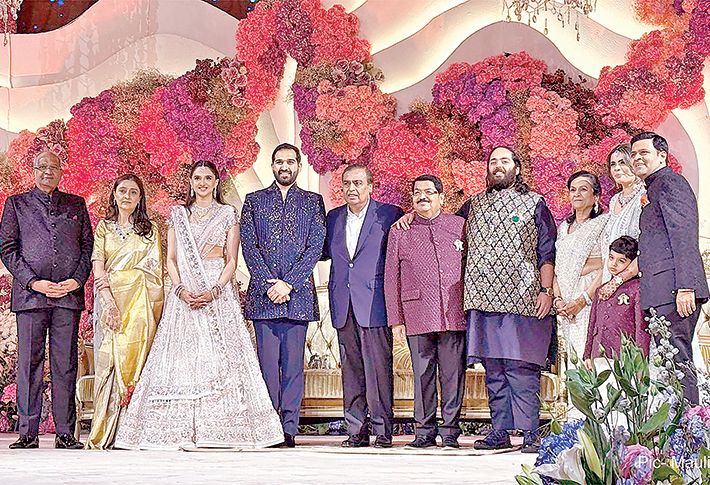
What the frame shows
A reception photograph of this type has a fixed grammar. The party arranges itself in a single line, facing forward, with the newly married couple placed near the centre. Nobody is caught mid-gesture. It is a formal record, closer to a group portrait than to reportage.
The backdrop does most of the visual work: a wall of pink, red and magenta blooms rising the full height of the stage, arranged in soft horizontal drifts rather than a flat panel. Floral installation on this scale is engineering as much as decoration — a supporting armature, irrigation or misting to keep cut stems fresh through a long evening, and a schedule that puts the final flowers in place only hours before guests arrive.
Note too what the clothes are doing. Reception dress differs from ceremony dress: the deep reds of the mandap give way to ivories, silvers and structured sherwanis. The change of palette signals the change of register from rite to celebration.
Afterwards
The last entry in the record
The final documented moment of the occasion is not a photograph but a message. On 25 November 2025, Parimal Nathwani posted publicly to thank those who had attended — naming Mukesh Ambani, Anant Ambani and the Ambani family for their warmth and good wishes, and adding his thanks to every guest who joined the celebrations.
It is a conventional courtesy, and that is precisely what makes it useful. The public record of this wedding opens with a guest list and closes with a thank-you. Everything in between — the vows, the long preparation, the two families’ own experience of the day — remains private, which is the ordinary condition of a wedding and no less true for this one having been reported.